Welcome to history of the world

This blog does what it says on the box. It quite simply narrates, from the start to the present day, a history of the world, and virtually everything of note in it. Follow the saga that the World's story is, by checking in for our daily updates! Contact us at worldhistoryblog@yahoo.co.uk

Search a topic:

Google
 
Showing posts with label Ancient Egypt. Show all posts

The formation of the ancient Egyptian state

Egyptologists in the early twentieth century interpreted the formation of the Egyptian state as a Darwinian process: the desiccation of the Sahara forced people into the Nile Valley, which gradually led to the development of villages, then ‘chiefdoms’. Over time, the chiefdoms were absorbed into two major Kingdoms, Upper Egypt (the Nile Valley), and Lower Egypt (the Delta). The two were united by the king Meni, who heads the Egyptian king lists. This process appears to have been achieved largely through military action and political marriages.

The formation of Egyptian civilization should be seen within a context of evidence from the whole of north-east Africa and western Asia. The evidence from Nubia shows a parallel development of stratified society there, and strong contacts with Upper Egypt, just as the evidence from the Delta indicates trade and contacts with Western Asia and Mesopotamia. In Upper Egypt the phases are named after the important site of Naqada, just north of Thebes. Our knowledge of the Predynastic era has been greatly enhanced by two sites of excavation – Nekhen and Aydos.

Early excavations at Nekhen found major monuments, such as ceremonial mace heads and slate palettes, which had been dedicated by the early ‘proto-pharaohs’, ‘Scorpion’ and Narmer. Many of the regalia and attributes of the pharaonic monarchy appear in the later Naqada phases: crowns, the bull’s tail attached to the belt, sandals, mace of club, flail and staffs. The evidence suggested that Nekhen rose to be the dominant kingdom of Upper Egypt and eventually conquered the north. More recent material excavated in the cemetery of Abydos suggests that the region of Tjeny may have supplanted Nekhen as the most important place in Upper Egypt a century or more before unification

In the Naqada II period (3800-3300 BC), there were major centres throughout Upper Egypt from Nekhen in the south to Abydos and Matmar, extending into northern Middle Egypt. By this phase, there was increasing social stratification to be seen in the cemetery sites at Abydos, Naqada and Nekhen. The elite burials are increasingly large and complex, employing mud-brick in their construction, and their contents reveal wide-ranging trading contacts with Nubia ad the Delta, and through the Delta with western Asia and Mesopotamia.

It is unclear what brought about this social change. Some archaeologists suggest that the more limited land available in Upper Egypt could have led to conflict and competition, hence providing the impetus for social complexity. The Naqada culture appears to have developed as the environment became more arid, forcing the cattle herders of the margins into the Nile Valley, where the population consisted mainly of fishermen and hunter gatherers. Indeed, the Egytian kingship displays strong similarities with that of East African cattle cultures.

Another important factor was the development of long-distance trade, and exploitation of resources. The Naqada II phase shows the beginning of urban centres as elite residences and also ceremonial and production centres. There is considerable evidence for craft specialization and for trade in gold and copper from the Eastern Desert. Seal impressions suggest the beginning of the administrative system. In the second half of the Naqada II phase the towns at Naqada and Nekhen were enclosed with walls, protecting the new centres of wealth.

The external contacts of Upper Egypt are important. The old idea of the ‘Dynastic Race’ has been abandoned now, but contacts with Sumer and Elam re revealed by artistic themes. How these contacts were effected is still controversial, and they may have been indirect. It is easier to document the very strong links with the culture of Lower Nubia.

In the Delta region, the dominant culture is named after the two sites of Maadi near Cairo and Buto in the western Delta. This Maadi-based culture had strong links with Canaan in South western Asia. There were also settled groups of people from the same regions, indicated by the local production of south Levantine vessels at Buto itself, and the evidence of a small number of houses of the Canaanite Beersheba culture on the outskirts of the Maadi settlement. There were certainly trading links across Sinai and exploitation of Sinai’s resources.

In the late Naqada II period, the Upper Egyptian culture expanded Northwards into that of Maadi-Buto. There is no evidence to indicate that this was a military conquest as was previously assumed. The result was a single state (the Naqada III phase) and an homogenous culture throughout Egypt. Large quantities of imported Canaanite storage and wine jars are not found in tombs. Vine cultivation was introduced into the Delta towards the end of the Naqada II period, and became an important feature of Egyptian agriculture. The Egyptians bureaucratic system also manifests itself at this time, with standardized and locally made wine jars in royal and elite burials.

The difficulties of dating Ancient Egypt

Extract from the King List in the Temple of Ramesses II, Abydos, now in the British Museum


The basic unit of Egypt’s ancient history is the dynasty. The most recent histories may count as many as 33 of these. These dynasties are then grouped into Kingdoms and Intermediary Periods, preceded and followed by other unnumbered dynasties and periods. This divides ancient Egyptian history into roughly ten divisions:

- The early Dynastic period: Dynasty 00 to dynasty 2
- The Old Kingdom: Dynasty 3 to Dynasty 7
- First Intermediate Period: Dynasty 8 to Dynasty 11 (part 1)
- Middle Kingdom: Dynasty 11 (part 2) to early Dynasty 13
- Second Intermediate Period: Dynasty 13 to Dynasty 17
- New Kingdom: Dynasty 18 to 20
- Third Intermediate Period: Dynasty 21 to the 24th Dynasty
- Late Period: Dynasty 25 to 31
- Macedonians
- Ptolemies
- Roman Period

Egyptian archaeology during the Dynastic Period has always been tied to the King list. This is important, because all artefacts in Egypt are tied directly or indirectly to material that is dated by royal association. This material is used to date Egyptian material in contexts outside Egypt too. The basic tool for establishing a chronology for ancient Egypt is the king list because the Egyptians themselves dated by regnal years. Some other ancient societies used an ‘era’ system, dating their calendars from specific events (the Greeks dated theirs from the first Olympic Games around 776 BC by our terms, while the Romans started from the foundation of the City of Rome. Some other societies, like the Mesopotamians used eponym lists, naming the year after the chief magistrates. Egypt used none of these systems, hence the importance of the king lists to historians and archaeologists.

The first process for Egyptology was to establish a complete king list. Before the decipherment of hieroglyphics, it was not possible to do this directly from the monuments, and scholarship relied on the evidence of Greek and Latin writers. The first history of Egypt was written by the Egyptian priest Manetho in the reign of Ptolemy II around 280 BC. Called Aigyptiaka (‘On things Egyptian’) it was written for the new Ptolemaic ruling dynasty, just as a near contemporary Babylonian, Berossos, wrote a history of Babylon for the new Seleukid dynasty. Each historian was setting out to prove that his country was the oldest, a matter of prestige to the new Macedonian rulers.

Manetho divided Egyptian history into 31 dynasties, each being a ruling family from a particular city. It’s most likely that Manetho based his own work on Egyptian written sources and traditions, and his dynastic framework probably has some sort of Egyptian tradition behind it. However, no complete version of Aigyptiaka survives, only abridgements, and the king lists are preserved in the writings of later authors. All ancient books were copied by hand, and with books such as this, error would inevitably creep in during the process of transmission. The most important writers to preserve Manetho’s work, are Flavios Josephos and the Christian chronographers Africanus and Eusabius.
With copying, abbreviation and corruption of texts, by AD 80 the preserved versions of Manetho were so far removed from the original that they were virtually useless. It is, perhaps, hard to see why Egyptologists put so much value on Manetho, but in reality, the first Egyptologists had little choice. The texts of Manetho were available for early European scholarship along with a great deal of other Greek and Roman literature, from the Renaissance onwards. Lacking direct access to monuments, and unable to read the hieroglyphic texts, scholars found in Manetho an outline chronology of ancient Egypt, which was then supplemented by information gleaned form Herodotus, Diodoros and many other scholars. Indeed, Jean-Francois Champollion, who is generally considered to be the founding father of modern Egyptology, increased Manetho’s authority when, in 1828, he announced that he could read the names of some of the Egyptian kings recorded by Manetho on monuments. Those kings were Achoris (Hakor), Nepherites (Nefaurud), Psammetichos (Psamtik), Osorcho (Osorkon), Sesonchis (Sheshonq), Rameses and Tuthmosis (Thutmose).

As well as using inconsistent Greek forms of Egyptian names, and occasionally repeating kings, the preserved king lists of Manetho also omit many rulers and the reign lengths rarely agree in the different versions. As his work survives, it is hopelessly garbled in places. But, despite all the problems associated with dynastic divisions, Manetho’s work is so ingrained in Egyptology that it is now impossible to get rid of it; and, despite the problems, the dynastic system is still useful as a basic unit of Egyptian history. Although there are overlapping dynasties, it is safe to assume that the higher the number, the later the dynasty; and remembering which important rulers – or monuments – belong to which dynasty, does help to for a broad cultural-historical framework.

In the early nineteenth century, scholars attempting to decipher hieroglyphic realized that the cartouche contained royal names and therefore began to assemble collections of all those that were visible on monuments. One of the first collections published was in the Description de l’Egypte, the result of the French scholarly expedition of 1798. it was also recognized that cartouches were usually paired; one carrying the personal name of the pharaoh and the other the name that he assumed when he ascended the throne. As European activity in Egypt increased, a number of important ancient king lists were found that aided in the reconstruction of the historical framework.

The Turin Canon of Kings is preserved on papyrus (not in the Museo Egizio, Turin) and dates from the time of Ramesses II. It was reputedly virtually intact when acquired by the French consul in 1823, but by the time Champollion got hold of it, it was a mass of fragments. A German scholar by the name of Gustav Seyffarth, began to examine these fragments in 1826. By looking closely at the fibres of the papyrus he was able to reconstruct sections of it. Despite the efforts of the other scholars, the papyrus ha sstill not been completely restored to everybody’s agreement. It carries a king list divided into groups, with totals of regnal years.

A fragmentary king list cared on a wall in the temple of Ramesses II at Abydos was unearthed by the scholarly traveller William Bankes in 1818, but left there. In 1837 it was removed and later acquired by the British Musem. This list carried cartouches of 52 kings, wit the throne names of rulers beginning with Meni and ending with Ramesses II. In 1825 another, similar list, the Karnak Table of Kings, was recognized, carved on the walls of a small chamber in the temple o Thotmose II at Karnak. The walls carry images of 61 Kings wit their cartouches, of which 48 were legible. In 1843 this was moved to the Louvre in Paris.

The most important of these king lists was found carved on a corridor wall in the temple of Sety I at Abydos during the clearance of the temple of Auguste Mariette. Richard Lepsius published a copy in 1863. The whole scene shows the pharaoh Sety I and the crown prince Ramesses (to be Ramesses II), making offerings to the names of ancestral kings. This list is perfectly preserved but there are certain political omissions such as the entire Second Intermediate Period, Hatshepsut, Akhenaten and his immediate successors.

The Table of Saqqara was found in 1861 in the tomb of an official of Ramesses II named Tjuneroy. It originally had 57 cartouches, some of which were already damaged by the time of their discovery. It is significant that these lists are already Ramesside and that such lists do not survive from other periods. In addition to the King lists, some temples and tombs at Thebes depict processions of royal statues in a similar chronological arrangement.

At the festival of the god of Min, there was a procession of royal statues. This is depicted in the temples of Rameeses II (the Ramesseum) and Ramesses III (Madinet Habu). The earliest ruler shown is Meni, the founder fo the Egyptian state; he is followed by Neb-hepet-ra (Mentjuhopet II) who reunited Egypt and founded the Middle Kingdom. These two pharaohs stand as shorthand for the whole of the Old and Middle Kingdoms. Neb-pehty-ra (Ahmose) reunited Egpyt, and is generally considered as the founder of the New Kingdom. He is followed by the statues of nearly all the pharaohs of the eighteenth and nineteenth dynasties to the reigning sovereign, Ramesses II or III; as is usual, Hatshepsut and the immediate successors of Amenhotep III are omitted.

In addition to these new Kingdom sources, fragments of an Old Kingdom list survive. This is generally known, after the largest surviving piece, as the Palermo Stone. The original document appears to have carried a complex historical text that recorded Old Kingdom rulers with information on their reigns, such as height of inundation, the foundation of temples and military activities. One of the major early organizers of the evidence from the monuments alongside the Greek, Roman and biblical traditions was Ippolito Rosellini (1800-1843), leader, with Champollion, of the joint Franco-Tuscan Egyptian expedition of 1828-29. Following Champollion’s untimely death, Rosellini published the vast amount of material gathered by the expedition in three parts: historical, religions and social. His synthesis of the historical evidence gathered all of the known ancient sources that could be read in Greek, Latin and Hebrew, attached them to Manetho’s chronology, and, wherever possible, added the newly read hieroglyphic cartouches and the monuments where they were to be found. Although Rosellini did not get everything correct, for the first time, Egyptian monuments had been ordered chronologically.

The geography of Ancient Egypt


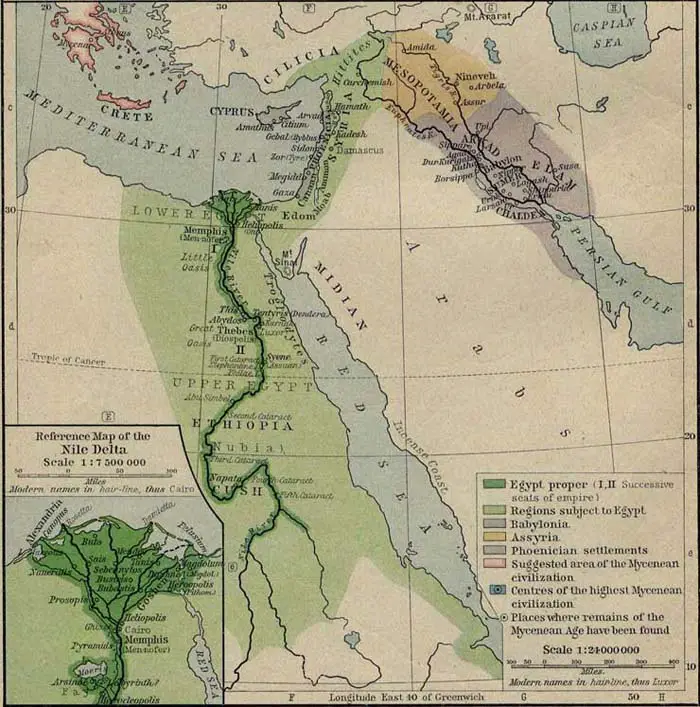
Ancient Egypt is unique in terms of geography. Unlike ‘ancient Greece’, which, culturally, embraced a region far wider than the narrow geographical limits of its modern namesake, or ‘Rome’, which was culturally diverse within its broad political boundaries, Egypt is closely defined in geographical terms. Yet ‘placing’ Egypt in the world is actually fraught with difficulties.

The most obvious answer to the question, “Where is Egypt?” is Africa. To an African-American or a British audience, this would be the first, and perhaps only location, not only in simple geographical terms, but in broader cultural and perceptual ones as well. Others might prefer to limit the reply with ‘north’, or ‘northeast Africa’, effectively separating Egypt from ‘black Africa’. Much early Egyptology viewed Egypt as distinctly African, but the borders were redefined in the 19th century, drawing a line across Sudan, south of which became the world of anthropology and ethnology rather than archaeology and written records to the north. Some Egyptologists have argued that there was an African basis to Egyptian culture and institutions, notably the kingship; others have preferred to treat Egypt as totally separate from Africa. There can be no doubt that the origins of Egyptian civilization lie in Africa.

But the name and perception of ‘Africa’ is itself of importance here. Today we tend to speak off Africa and ‘African’ peoples and cultures as if somehow they are an homogenous entity. This in itself is a residue of colonial attitudes that denies the variety and complexity of cultures and peoples in that vast continent (indeed, the very name ‘Africa’ is an example of such generalization. Deriving from the name of a small tribal group in Tunisia, Africa was the name given to a Roman province, and then became more widely applied by the Byzantines, and then the Arabs – who called it ‘Ifriqiya’ – who used it as a general term for north-west Africa. It was adopted by the Europeans for the same region, and then it later came to be applied by them to the whole continent).

In European academic circles, in museums and universities, Egypt has been included in the ‘Near East’ for a range of reasons. The Near East was a term used to refer to the Ottoman Empire, and was more geographically accurate as a description, than the present term ‘Middle East’ (the Middle East is now mistakenly used to refer to the Islamic world as a whole, and in turn, the Islamic world seems to be a blanket term for the Arab world!) The near east as a region is unique for the fact that it has played host to virtually every significant ancient Empire there has been.

These two placings of Egypt – Africa and near East – represent not quite opposed points of view. Locating Egypt raises issues about how Europeans, who are largely those who have written Egyptology, have viewed Egypt both as part of, and distinct from ‘Africa’. It is also a useful conception to have when talking about the cultural influences that came through and from Egypt. Modern perceptions of where Egypt is are very different to those of the past. To the Greeks, ‘Egypt’ was the land of the Nile valley, bounded by Asia on the east, ‘Libya’ (their name for North Africa in general) on the west, and Aithopia (the name given to pretty much anything south of North Africa). The Greek name, Aigyptos (Aegyptus in Latin) derives from the name given to the city of Memphis, Hut-ka-Ptah, meaning ‘the house of the Soul of Ptah’. In the languages of western asia, the country was known as Musri or Misr, and this is the name we find in Assyrian and biblical texts. To the Assyrians, Egypt was in the west. The Assyrian records of the Sargonid Period (721-626 BC) refer to the pharaoh as the ‘King of the Westland’. The Kushites thought of Egypt as ‘north’, lying downstream on the same river. To the Romans, and their cultural heirs, Egypt was in the East, the Orient.

Ancient Egypt: The Old and Middle Kingdoms

Among the harsh deserts of northeast Africa, it was only the River Nile which made the development of an advanced civilization possible. In the late sixth millennium BC, farming was introduced from Palestine. The unique advantages of the Nile made a dramatic increase of the population possible. In the fourth millennium villages increased in size, until the first walled towns appeared in southern Egypt, around 3300 BC. Some historians and archaeologists believe that these developments should be regarded as mainly local achievements, but others aver that it was the impact of influences from Sumer which caused the sudden flowering of civilization in the Nile valley. There is indeed evidence of Mesopotamian influence in the formative phase of Egyptian civilization. It also seems unlikely that the two earliest civilizations of the Middle East arose by chance, almost simultaneously, without influencing each other. Whether there was any connection or not, the Egyptian Civilization quickly developed in a very different manner to the Sumerian one.

Ancient Egyptian history is basically the story of three lengthy periods of flourishing civilization, divided by shorter, intermediate periods of decline and dissolution. The Old Kingdom lasted for 850 years, from 3100-2250BC) and was the most impressive era of Egyptian history. Most of the time the country was ruled by a strong, unified monarchy, engaged only rarely in foreign wars of conquest, being apparently content with what it had. Its capital was Memphis, near present day Cairo. The use of the waters of the Nile for agricultural purposes throughout the land, necessitated an efficient administration and a strong, central authority. It is therefore not surprising that the pharaohs were soon regarded as divine.

A detailed list of kings has come down from Hellenistic times, which conveniently groups these kings as dynasties. Six of them are allotted to the Old Kingdom. The central position of the king n Egyptian life is shown by the enormous effort invested in building his tomb. The fact of death was seemingly denied and great care was taken to equip him properly for his existence in the afterlife. Around 2650 BC, the Third Dynasty started to build stepped pyramids for the pharaoh’s last resting place, but these pyramids only reached their full development under the Fourth Dynasty kings Khufu around 2540 BC and Khafre. Khufu’s pyramid is 147 metres high and consists of over 2 million blocks each weighing 2.5 tonnes. It still is to this day, one the largest buildings ever erected.

Egyptian Art was perhaps even more impressive. It was highly refined even at its inception early in the third millennium. The statuary is striking and lifelike, retaining a timeless appeal throughout its 5000 year history. It shows, for instance, pharaohs and their families marching towards the beholder, full of self-assurance, in spite of their scant apparel. The scene depicts squatting scribes alertly awaiting dictation, erect officials in dignified pose, and conscientious women at work.

Society
Initially, Egypt was a nearly classless society, with no real aristocracy. The sons of simple farmers could, and occasionally did, ascend the ladder to very high office in an administrative career. But in time, a class of professional bureaucrats appeared, with sons following their fathers in government and administrative roles. It is interesting that there appear to have been no private merchants, with all mercantile activity being done on the king’s behalf by officials. The accumulation of massive private wealth was difficult due to the laws of inheritance, which obliged a father to divide his property equally among his sons. Nevertheless, by the end of the Old Kingdom, a new class of landowners was becoming increasingly powerful. At this time, real slavery was unknown, though free farmers were sometimes forced to become serfs.

Religion
Religion in ancient Egypt was a regional affair: Atum-Re was worshipped in Heliopolis; Ptah in the capital Memphis; Osiris and Isis in the Nile delta; Anubis, with his iconic dog-head, in assiut. Only Horus, the falcon headed one, was worshiped over a wide area. There was also a strong belief in life after death in a world presided over by Osiris, and it is for this belief that the Egyptian mummification burial techniques were practiced. Much of what is known about Egyptian religion is gathered from inscriptions in the small pyramids of the VI Dynasty. Hieroglyphic writing is quite unlike Sumerian cuneiform. Although it was written on papyrus rather than on clay tablets, it was only much later that phonetic-syllabics developed.

The conservative adherence to old habits and customs became even more typical of Egypt as her civilization grew older. At the close of the VIth Dynasty, too much government land had passed into private hands, seriously undermining the income of the state. Central power declines and pharaohs reigned for shorter periods, with local governments becoming over-powerful. A relatively short period of decline ensued. Prosperity and strong government were restored by the time of the Middle Kingdom (the XI-XII Dynasties, 2130 -1786 BC)). Its dominant characteristic was continuity. Changes in religion, in art, and in administration were minimal, but the social structure became more hierarchical. Literature flourished during this period, bringing us such tales as “Thousand and One Nights”. Science was also developing, and we have surviving mathematical writings from the time.

Foreign policy became more aggressive. Egyptian expeditions to Nubia and the Land of Canaan had, however, commenced already, during the VI Dynasty. They were continued and intensified during this time. Undoubtedly the darkest period in Ancient Egyptian history, was the second intermediary period of decline and chaos, after the Middle Kingdom came to an end. It lasted from 1786 to 1590 BC. For a while during the later stage of this period, Egypt was dominated by the Semitic Hyksos.