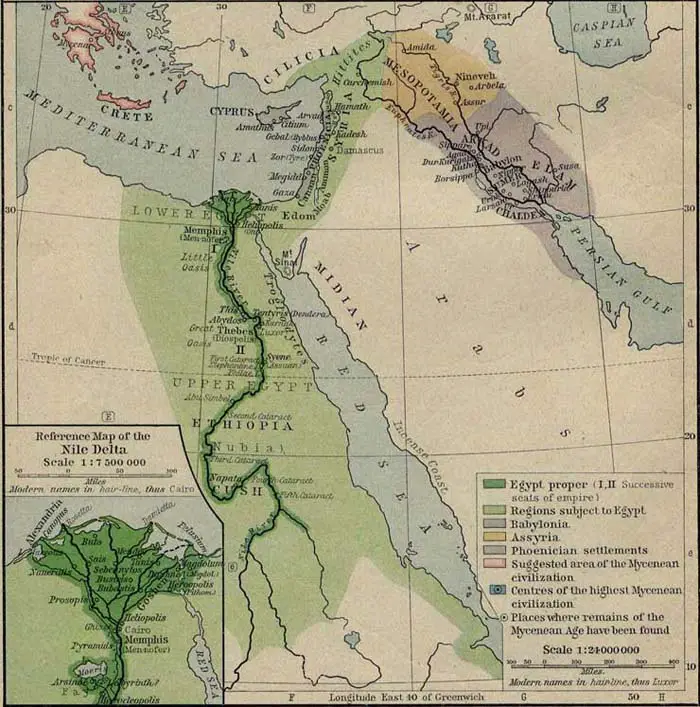
Ancient Egypt is unique in terms of geography. Unlike ‘ancient Greece’, which, culturally, embraced a region far wider than the narrow geographical limits of its modern namesake, or ‘Rome’, which was culturally diverse within its broad political boundaries, Egypt is closely defined in geographical terms. Yet ‘placing’ Egypt in the world is actually fraught with difficulties.
The most obvious answer to the question, “Where is Egypt?” is Africa. To an African-American or a British audience, this would be the first, and perhaps only location, not only in simple geographical terms, but in broader cultural and perceptual ones as well. Others might prefer to limit the reply with ‘north’, or ‘northeast Africa’, effectively separating Egypt from ‘black Africa’. Much early Egyptology viewed Egypt as distinctly African, but the borders were redefined in the 19th century, drawing a line across Sudan, south of which became the world of anthropology and ethnology rather than archaeology and written records to the north. Some Egyptologists have argued that there was an African basis to Egyptian culture and institutions, notably the kingship; others have preferred to treat Egypt as totally separate from Africa. There can be no doubt that the origins of Egyptian civilization lie in Africa.
But the name and perception of ‘Africa’ is itself of importance here. Today we tend to speak off Africa and ‘African’ peoples and cultures as if somehow they are an homogenous entity. This in itself is a residue of colonial attitudes that denies the variety and complexity of cultures and peoples in that vast continent (indeed, the very name ‘Africa’ is an example of such generalization. Deriving from the name of a small tribal group in Tunisia, Africa was the name given to a Roman province, and then became more widely applied by the Byzantines, and then the Arabs – who called it ‘Ifriqiya’ – who used it as a general term for north-west Africa. It was adopted by the Europeans for the same region, and then it later came to be applied by them to the whole continent).
In European academic circles, in museums and universities, Egypt has been included in the ‘Near East’ for a range of reasons. The Near East was a term used to refer to the Ottoman Empire, and was more geographically accurate as a description, than the present term ‘Middle East’ (the Middle East is now mistakenly used to refer to the Islamic world as a whole, and in turn, the Islamic world seems to be a blanket term for the Arab world!) The near east as a region is unique for the fact that it has played host to virtually every significant ancient Empire there has been.
These two placings of Egypt – Africa and near East – represent not quite opposed points of view. Locating Egypt raises issues about how Europeans, who are largely those who have written Egyptology, have viewed Egypt both as part of, and distinct from ‘Africa’. It is also a useful conception to have when talking about the cultural influences that came through and from Egypt. Modern perceptions of where Egypt is are very different to those of the past. To the Greeks, ‘Egypt’ was the land of the Nile valley, bounded by Asia on the east, ‘Libya’ (their name for North Africa in general) on the west, and Aithopia (the name given to pretty much anything south of North Africa). The Greek name, Aigyptos (Aegyptus in Latin) derives from the name given to the city of Memphis, Hut-ka-Ptah, meaning ‘the house of the Soul of Ptah’. In the languages of western asia, the country was known as Musri or Misr, and this is the name we find in Assyrian and biblical texts. To the Assyrians, Egypt was in the west. The Assyrian records of the Sargonid Period (721-626 BC) refer to the pharaoh as the ‘King of the Westland’. The Kushites thought of Egypt as ‘north’, lying downstream on the same river. To the Romans, and their cultural heirs, Egypt was in the East, the Orient.
The most obvious answer to the question, “Where is Egypt?” is Africa. To an African-American or a British audience, this would be the first, and perhaps only location, not only in simple geographical terms, but in broader cultural and perceptual ones as well. Others might prefer to limit the reply with ‘north’, or ‘northeast Africa’, effectively separating Egypt from ‘black Africa’. Much early Egyptology viewed Egypt as distinctly African, but the borders were redefined in the 19th century, drawing a line across Sudan, south of which became the world of anthropology and ethnology rather than archaeology and written records to the north. Some Egyptologists have argued that there was an African basis to Egyptian culture and institutions, notably the kingship; others have preferred to treat Egypt as totally separate from Africa. There can be no doubt that the origins of Egyptian civilization lie in Africa.
But the name and perception of ‘Africa’ is itself of importance here. Today we tend to speak off Africa and ‘African’ peoples and cultures as if somehow they are an homogenous entity. This in itself is a residue of colonial attitudes that denies the variety and complexity of cultures and peoples in that vast continent (indeed, the very name ‘Africa’ is an example of such generalization. Deriving from the name of a small tribal group in Tunisia, Africa was the name given to a Roman province, and then became more widely applied by the Byzantines, and then the Arabs – who called it ‘Ifriqiya’ – who used it as a general term for north-west Africa. It was adopted by the Europeans for the same region, and then it later came to be applied by them to the whole continent).
In European academic circles, in museums and universities, Egypt has been included in the ‘Near East’ for a range of reasons. The Near East was a term used to refer to the Ottoman Empire, and was more geographically accurate as a description, than the present term ‘Middle East’ (the Middle East is now mistakenly used to refer to the Islamic world as a whole, and in turn, the Islamic world seems to be a blanket term for the Arab world!) The near east as a region is unique for the fact that it has played host to virtually every significant ancient Empire there has been.
These two placings of Egypt – Africa and near East – represent not quite opposed points of view. Locating Egypt raises issues about how Europeans, who are largely those who have written Egyptology, have viewed Egypt both as part of, and distinct from ‘Africa’. It is also a useful conception to have when talking about the cultural influences that came through and from Egypt. Modern perceptions of where Egypt is are very different to those of the past. To the Greeks, ‘Egypt’ was the land of the Nile valley, bounded by Asia on the east, ‘Libya’ (their name for North Africa in general) on the west, and Aithopia (the name given to pretty much anything south of North Africa). The Greek name, Aigyptos (Aegyptus in Latin) derives from the name given to the city of Memphis, Hut-ka-Ptah, meaning ‘the house of the Soul of Ptah’. In the languages of western asia, the country was known as Musri or Misr, and this is the name we find in Assyrian and biblical texts. To the Assyrians, Egypt was in the west. The Assyrian records of the Sargonid Period (721-626 BC) refer to the pharaoh as the ‘King of the Westland’. The Kushites thought of Egypt as ‘north’, lying downstream on the same river. To the Romans, and their cultural heirs, Egypt was in the East, the Orient.


